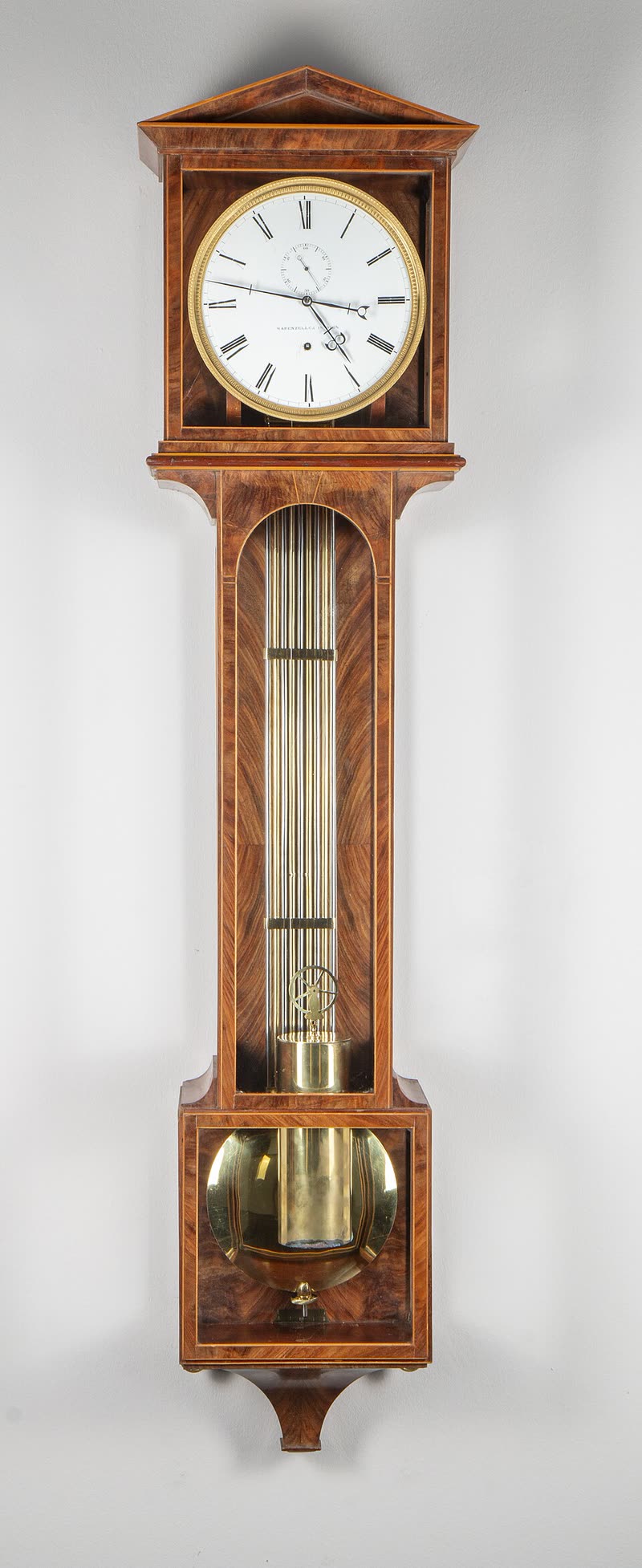
A Vienna regulator on your screen
This page loads Westminster Chime with the Vienna regulator selected, a glazed wall clock with a slim pendulum behind its glass door. Once started, it ticks every three quarters of a second, plays the Westminster chime every quarter hour on clear, bright tones, then strikes the hour.
The notes, the hour gong and the tick are recordings of a real Gustav Becker wall clock from the 1920s, replayed by the site as the hours go by.
A crisp beat and a crystal tone
The Vienna regulator has the most precise voice of the Westminster clocks on this site. Its tick is quick and clean, about eighty beats a minute, without the woody looseness of the Comtoise.
The chime is bright and glassy, a little shorter than the rods of the grandfather clock, so the melody stays articulate even at a low volume.
What a regulator is
In clockmaking, a regulator is a precision clock kept as a reference for setting other clocks. The name stuck to a family of elegant wall clocks that appeared in Vienna around 1800, during the Biedermeier period, with tall, narrow glazed cases that let you watch the pendulum and the weights.
The chime on this page was recorded on a Gustav Becker wall clock from the 1920s that plays the Westminster melody, then cut into single notes so the site can ring every quarter.
Good for focused work
Its faster tick gives a sense of quiet momentum that suits working or studying, while the chime stays discreet. If you want the opposite, no tick and the deep strike of a great bell, switch to Big Ben.
Questions
What is a Vienna regulator?
A glazed wall clock from Vienna, first made around 1800. “Regulator” originally meant a precision clock used as a reference to set other clocks.
How fast does the Vienna regulator tick here?
Every 0.75 seconds, about 80 beats per minute: quicker than the Comtoise or the grandfather clock.
Can I hear the regulator without the chime?
Yes. Turn the chime off in the settings to keep only the tick, or turn the tick off to keep only the quarter-hour chime.