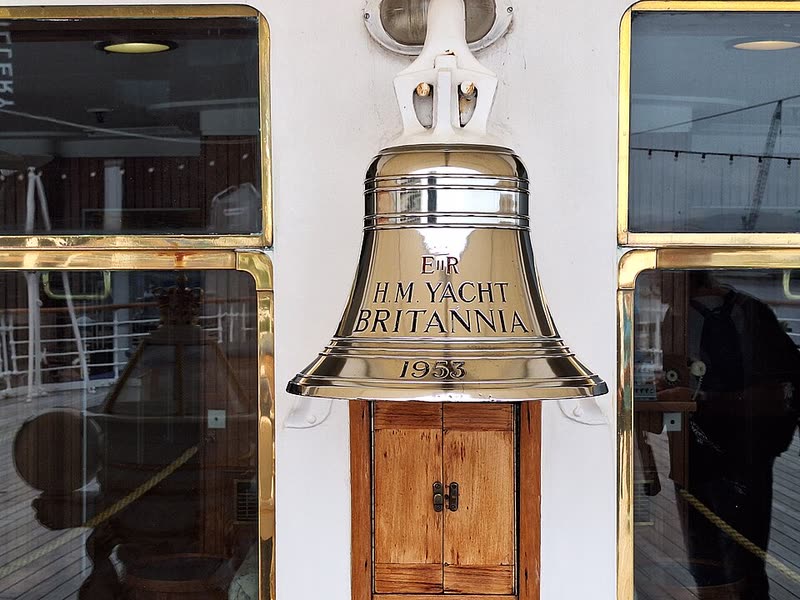
Time kept the sailor's way
This page opens Westminster Chime with the ship's bell selected. It does not count the hours like a house clock. Every half hour it rings one bell more, from one bell to eight, then starts again: eight bells at 4, 8 and 12 o'clock, morning and evening.
The strokes come in pairs, with any odd one at the end, so three bells sound like two quick strokes and a single one. The sound is a recording of a real ship's bell, replayed by the site at each half hour.
Why eight bells?
On board, the crew works in watches of four hours. Before chronometers, time at sea was measured with a half-hour sandglass: each time the sand ran out, the glass was turned and the bell was struck, once more than the time before.
After eight half hours, eight bells mark the end of the watch and the next one begins. The striking in pairs simply makes the count easier to follow over the noise of a ship.
A bell, not a tick
This clock has no ticking. The tick controls are greyed out when you choose it. What remains is the clear, bright ring of a brass bell every thirty minutes.
When to choose it
The ship's bell suits anyone who works in long, focused stretches: every bell tells you how far into the four-hour block you are, without a melody to distract you. For a melody on the half hours instead, the Vienna regulator plays the Westminster chime.
Questions
Why does the ship's bell ring eight times at noon?
Because noon ends a four-hour watch. The bell counts the half hours of the watch, so the eighth half hour is eight bells, at 4, 8 and 12 o'clock.
Is this a real ship's bell?
Yes. It is a recording of a real ship's bell, shared under a Creative Commons licence and credited on this page. The site plays it in pairs at each half hour.
Why is there no ticking?
On board, the bell itself marks the time, every half hour, so this clock has nothing to tick: it just rings.