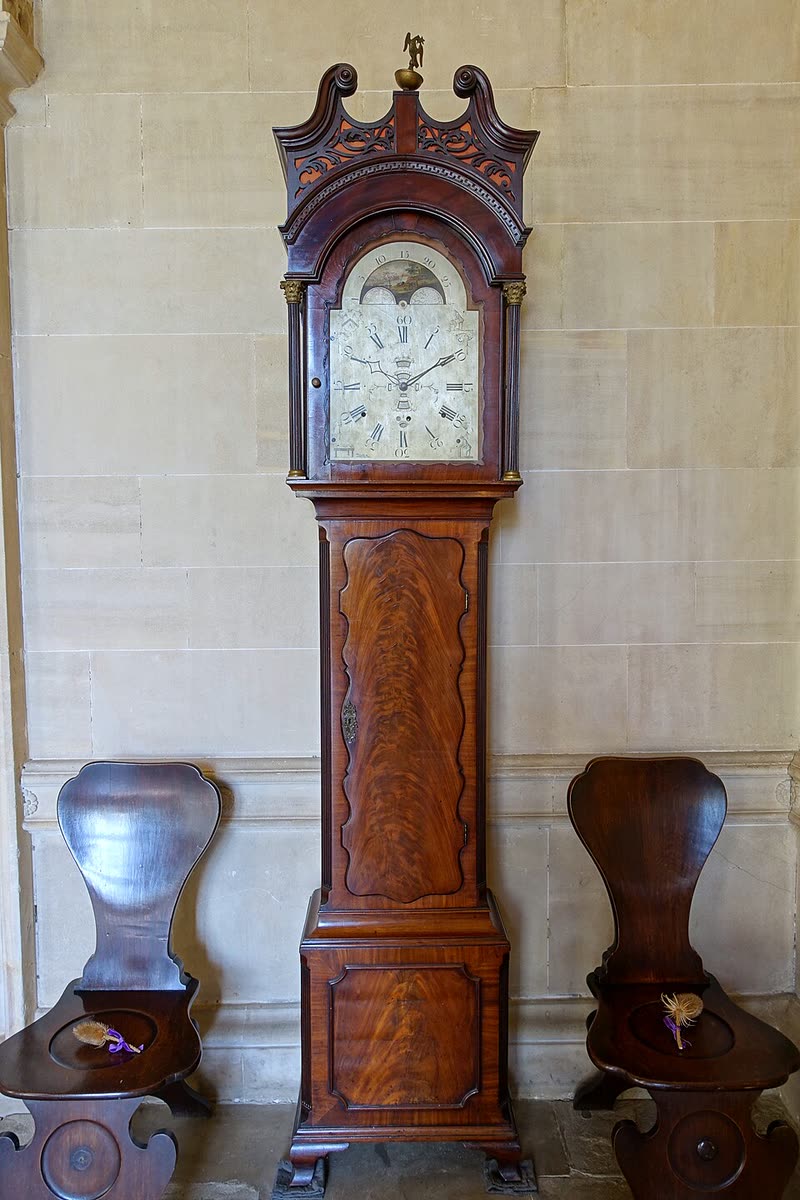
A grandfather clock that chimes online
Here Westminster Chime starts with the grandfather clock selected: an English longcase in mahogany, with a moon dial above the hands. Start it and leave the tab open. It ticks once a second, plays the Westminster chime every fifteen minutes and then counts out the hours.
Every note comes from a recording of a real clock with a Kieninger rod movement, replayed by the site at the right moment, so the chime always tells the actual time.
Steel rods and a seconds beat
This clock rings its melody on tuned steel rods rather than on a bell: a clear, shimmering tone with a soft metallic edge and a long decay. The tick is a firm, even beat of one second, the rhythm of a pendulum about a metre long.
Next to the rustic bell of the Comtoise it sounds more formal, like a clock standing in a hallway or a study.
From longcase to grandfather
Tall case clocks appeared in England around 1670, soon after the anchor escapement made it practical to use a long pendulum. A pendulum that beats exactly once a second is close to one metre long, too long and too delicate to leave in the open, so clockmakers enclosed it in a wooden case standing on the floor. That is why the British still call them longcase clocks.
The friendlier name came later. In 1876 the American songwriter Henry Clay Work published “My Grandfather's Clock”, a song about a clock that stopped when its old owner died. It was a hit, and the name “grandfather clock” has stuck ever since.
A clock for the whole house
The grandfather clock is a good default if you want the classic sound that most people link with a chiming clock at home. It carries well, and its tick is steady without being intrusive. For something brighter and more precise, try the Vienna regulator.
Questions
Why is it called a grandfather clock?
Because of the 1876 song “My Grandfather's Clock” by Henry Clay Work. Before that, and still today in Britain, the usual name was longcase clock.
How often does a grandfather clock tick?
Usually once a second, because its pendulum, about a metre long, takes one second per swing. This one does the same.
Does this grandfather clock chime on bells or rods?
On rods. The notes are recordings of tuned steel chime rods, which give a clearer, more metallic tone than a cast bell.