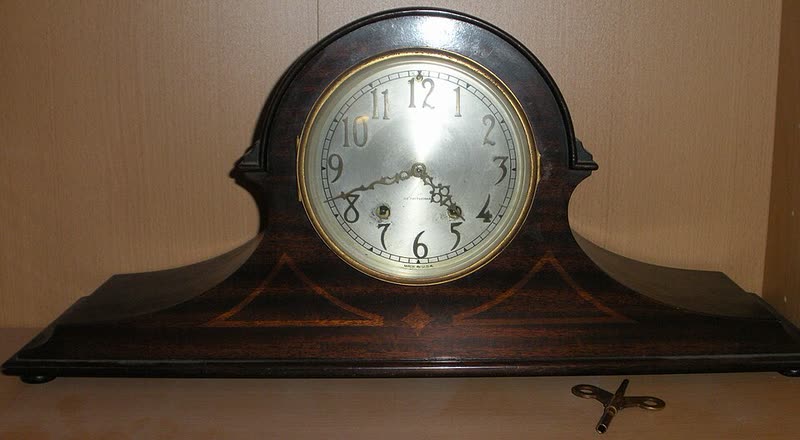
A mantel clock for your desk
Westminster Chime opens here with the mantel clock, the small arched clock that sits on a mantelpiece or a sideboard. Start it and leave the tab open: it ticks briskly, plays a light Westminster chime every quarter of an hour, then strikes the hours.
Its notes and its tick are recordings of real mantel clocks from the 1930s and 1940s, replayed by the site at the right moment.
Small clock, quick tick
A short pendulum swings fast, and this clock ticks every 0.4 seconds, two and a half beats a second. The tick is light and dry, closer to a metronome than to the slow beat of a floor clock.
The chime comes from the rods of a small 1930s mantel clock: lighter and shorter than those of the grandfather clock, which gives it a delicate, almost tinkling character.
The Napoleon hat
The clock drawn here has the arched outline often called a “Napoleon hat”. It is a typical silhouette for a chiming mantel clock: small enough for a shelf, with the movement and the chime rods tucked inside a wooden case.
Like the Big Ben clock face, it has no seconds hand, so the only thing you see moving is the minute hand.
A lively companion
Because its tick is fast and quiet, the mantel clock suits a desk or a bedside better than a large room. It keeps a sense of time passing without the weight of a tower bell. You can lower the tick volume independently of the chime, or set quiet hours so that it stays silent at night.
Questions
Why does the mantel clock tick so fast?
Its pendulum is short, so it swings quickly: here every 0.4 seconds, two and a half times faster than a grandfather clock.
Does the mantel clock have a seconds hand?
No. This mantel clock shows only hours and minutes, so the seconds hand option has no effect on it.
Is the mantel chime softer than the others?
It is lighter and shorter, recorded on a small mantel clock rather than a floor clock. You can also set its volume separately from the tick.